News Next article
Rental market heats up with first national increase for 2026
Rental Price Index - April 2026
By Casey Wylde 19 May 2026The national median weekly rent has recorded its first month-on-month increase since November 2025, rising by $5 to $625 in April, according to the latest Trade Me Property Rental Price Index.
While rents are still $5 cheaper compared to the same time last year, this figure masks the underlying pressure in the market. Trade Me Property spokesperson Casey Wylde says a mismatch between supply and demand is the main reason for the intensifying competition.
"Nationally, the number of rental properties available was down by 5% in April compared to last year, while demand was up 8%. This is creating a more competitive environment for tenants, and we expect this to put upward pressure on prices in the coming months."
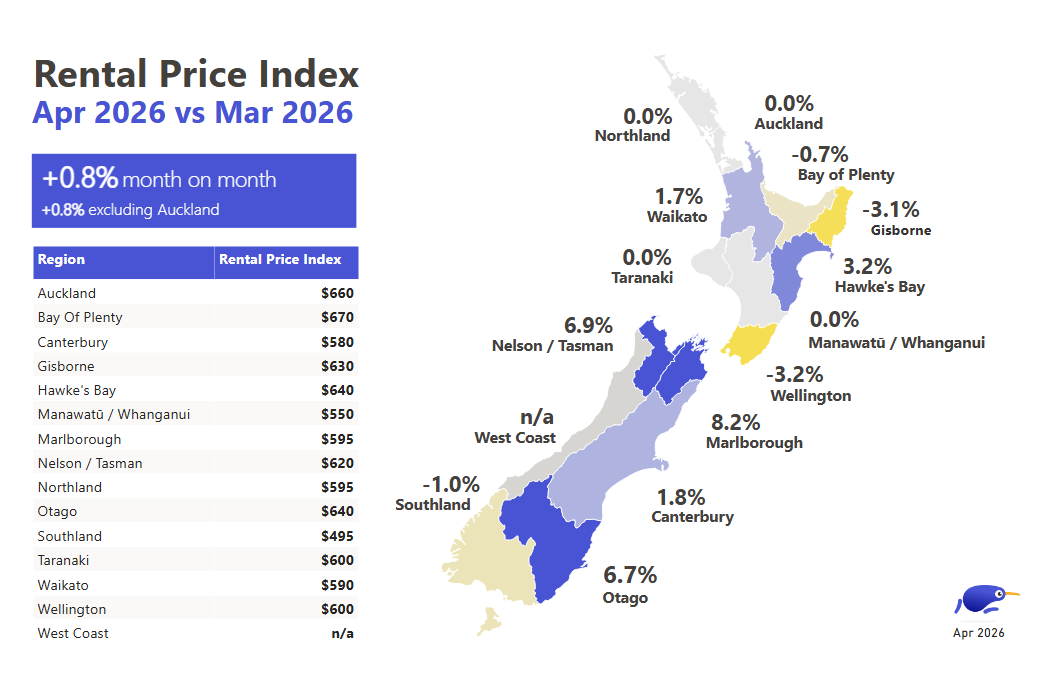
Median weekly rents by region, April 2026
Regional markets drive the trend
This national tightening is playing out strongly across much of the country, with regional markets closely reflecting the overall squeeze on supply.
"Rental prices in Otago and the Bay of Plenty are continuing to climb," says Wylde. "The Bay of Plenty remains New Zealand's most expensive region to rent for the third month running, with the median weekly rent at $670, which is a $10 increase on last year. Otago had the biggest jump with a $40 annual increase, taking its median rent to $640."
"The supply and demand dynamic explains a lot of this," says Wylde. "In Taranaki, for example, a 30% increase in new listings has kept prices flat, with no growth compared to last
year. On the flip side, an eight percent drop in supply for Otago has pushed prices up, showing how sensitive regional markets are to the number of available homes - especially in these smaller regions."
Main centres still dropping in rents
While the regions heat up, the storyline flips in the country's largest cities, where prices are still dropping
"Despite an 11 per cent increase in demand and a 5 per cent drop in supply Auckland has seen the median weekly rent drop by $10 annually to $660," says Wylde. "Wellington also saw a significant drop, with rents falling by $40 to $600 a week compared to last year."
Renters in Gisborne are also seeing savings, with the median weekly rent dropping by roughly $55 compared to last year, landing at $630.
"While Gisborne has seen a temporary increase in listings which has provided relief for renters, the broader national trend points towards a tightening market. Where supply is constrained, landlords will have less need to lower their prices."
Prices drop for apartment and townhouses
When it comes to rental prices in March, size made all the difference. New Zealanders are still showing they're willing to pay more for a bigger home.
"If you're looking for a large family home, you'll find the market is still very competitive," says Wylde. "Prices for these properties are going up, even while others are dropping. For example, rent for homes with 5 or more bedrooms rose by 1.0 per cent across the country, and by a huge 5.6 per cent in Christchurch."
On the other hand, it's a different story for apartments and townhouses, which saw prices fall. The typical apartment now costs $550 per week after a 1.8 per cent drop, while townhouse rents fell 3.1 per cent to $630.
"Landlords of smaller, inner-city properties seem to be realising they have to lower their prices to meet the market," says Wylde. "But renters shouldn't get too comfortable. There are fewer rentals on the market and demand hasn't gone away, so the lower prices we're seeing now could disappear quickly.
New record high for family homes in Christchurch
Christchurch families are facing a highly competitive market, pushing the median weekly rent for a three-to-four-bedroom house to a new record high of $660.
"While the broader rental market is cooling down, it's a very different story for families needing more room," says Wylde. "Quality family homes are still highly sought after. In Christchurch especially, the demand for these mid-to-large sized houses is so strong that we're seeing prices hit new peaks."
This strong demand for space is holding prices up for larger homes across the country, even as the rest of the market softens. Nationally, the median rent for large houses with five or more bedrooms continues to creep up, while prices for one-to-two-bedroom properties have stayed completely flat year-on-year.
“The market is moving at different speeds depending on what you're looking for," Wylde explains. "While prices for smaller apartments and units have managed to stay flat, the reality is that overall national supply is actually down 5 per cent. With fewer properties on the market overall, the competition for a family home is very real.”
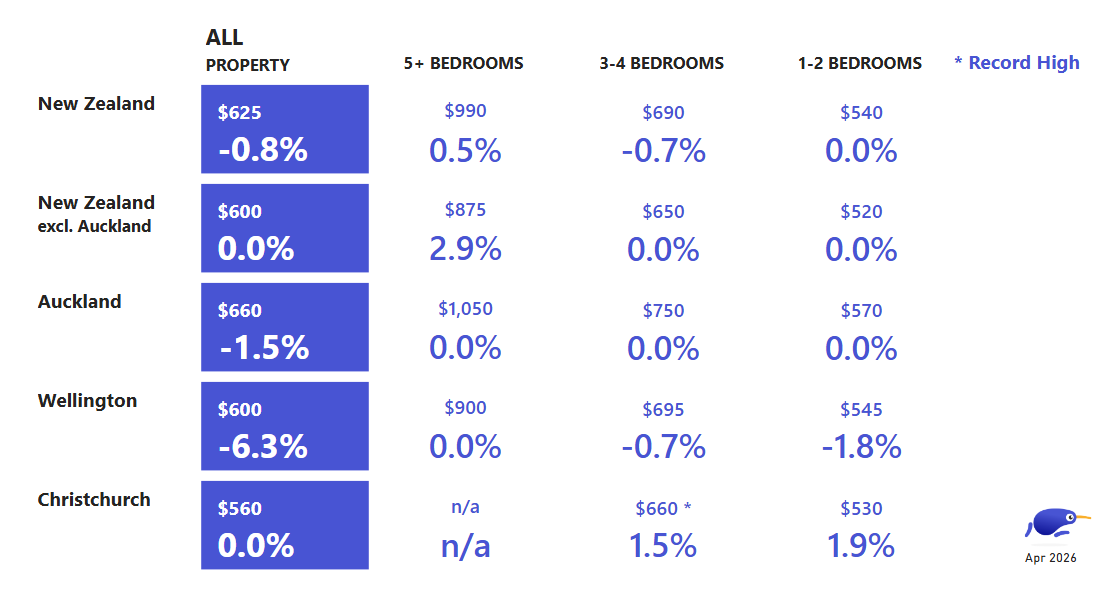
Median weekly rent by property type, and region. April 2026
| Region | Rental Price Index | ||
|---|---|---|---|
| Auckland | Auckland | $660 | $660 |
| Bay of Plenty | Bay of Plenty | $670 | $670 |
| Canterbury | Canterbury | $580 | $580 |
| Gisborne | Gisborne | $630 | $630 |
| Hawke's Bay | Hawke's Bay | $640 | $640 |
| Manawatu/Whanganui | Manawatu/Whanganui | $550 | $550 |
| Marlborough | Marlborough | $595 | $595 |
| Nelson/Tasman | Nelson/Tasman | $620 | $620 |
| Northland | Northland | $595 | $595 |
| Otago | Otago | $640 | $640 |
| Southland | Southland | $495 | $495 |
| Taranaki | Taranaki | $600 | $600 |
| Waikato | Waikato | $590 | $590 |
| Wellington | Wellington | $600 | $600 |
| West Coast | West Coast | NA | NA |

Author