2026 Mazda CX-5 review
Is the Mazda CX-5 still a segment leader? We tested not one, but two different trim levels to find out.

They say ‘if it ain't broke, don’t fix it’. And that’s exactly how Mazda operated when it came to its second generation CX-5.
Such was the confidence in its execution that Mazda’s outgoing CX-5 only saw a handful of tiny updates over almost a decade of being on sale in New Zealand and around the world. And while most models that go without big changes for long periods of time get treated by customers and pundits like grapes withering on the vine, the second-gen CX-5 was still copping praise right up until it was replaced.

The third-generation CX-5 is officially here, and with it comes an interesting mix of familiarity and new.
On one hand, it looks a lot like the old one and it skips electrification in favour of a naturally aspirated 4-cylinder (for the time being at least … ). On the other hand, Mazda has flipped the CX-5’s cabin on its head with a bigger boot, bigger back seat, and a greater focus on technology.
These changes come amid an influx of new mid-size SUV contenders from new Chinese brands. And some of these models, like the GWM Haval H6 and BYD Sealion 5, are already making a big splash amongst customers.
Is the CX-5 still a segment leader? We tested not one, but two different trim levels — an SP and a Takami — to find out.

How much does the Mazda CX-5 cost?
The Mazda CX-5 lands here with a fairly straightforward line-up consisting of four variants, all equipped with the same 2.5-litre petrol engine and all-wheel drive.
The range starts at $46,490 for the Touring, which is pretty sound pricing for something with all-wheel drive as standard. The cheapest all-paw Toyota RAV4 is the $54,990 GX E-Four, whilst you’ll pay $47,490 for the equivalent Mitsubishi Outlander LS AWD.
Nissan currently takes the cake for cheapest AWD mid-size SUV, at $42,990 for the X-Trail ST, which has a $6000 discount on its regular price of $48,990 at the time of writing.

| Model | Price not including on-road costs |
|---|---|
| Mazda CX-5 Touring AWD | $46,490 |
| Mazda CX-5 SP AWD | $49,990 |
| Mazda CX-5 Homura AWD | $57,990 |
| Mazda CX-5 Takami AWD | $61,990 |
We drove the volume pick SP (blue) and flagship Takami (red) for this test, priced at $49,990 and $61,990, respectively. Having previously been offered for $67,980, the Takami has experienced a haircut of sorts — giving the nameplate a bit of breathing room to the more premium-orientated $69,990 CX-60.

Although it's well priced, I do wonder whether a more affordable 2-wheel drive CX-5 could help the nameplate better combat some of its more cut-price rivals like the Haval H6, which starts at $41,990.
The CX-5 comes with Mazda's 5-year/unlimited kilometre warranty, with five years of roadside assist.


What is the Mazda CX-5 like inside?
The CX-5’s new interior represents the biggest pivot from Mazda's cabins in quite some time.
Gone is the rotary dial that controls everything in the touchscreen and gone too are a lot of the physical buttons that this model has previously been known for. In their place, you get a large and very well presented touchscreen smack dab in the centre of the dashboard, which carries more responsibility than it did previously.


Beyond the touchscreen, the dashboard itself is a lot more minimalist than CX-5’s of old, and sees this model fall into line with a lot of other midsize SUV contenders — particularly those from China. Barring the functions on the steering wheel, physical buttons are few and far between.
Mazda has been much more daring with its colour palette choices, as evidenced by the two cars that we tested. The SP comes with a fetching two-tone black and white ensemble, its seats combining faux leather and suede appointments. Its interior colour combination is actually my pick of the CX-5 range, and looks quite ‘flagshipy’ for a mid-spec car. The Takami, meanwhile, comes with a familiar tan upholstery that’s also pretty fetching.


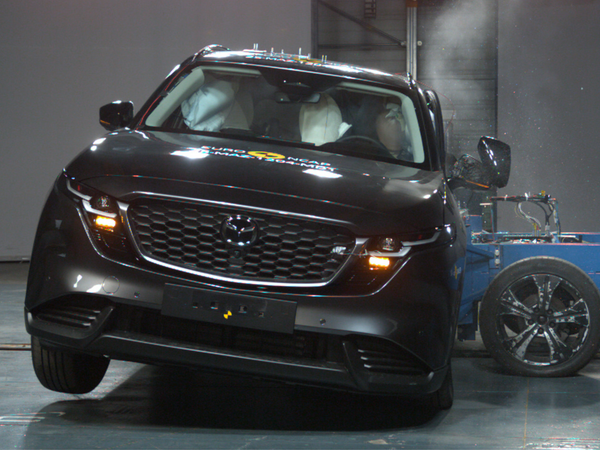
Spare a thought for the entry-level CX-5, too. The Touring comes with a pretty solid equipment list that includes the same screens as all of the other trims, heated front seats, and Mazda’s full suite of safety spec (the CX-5 boasts a 5-star ANCAP safety rating).
The ramp up in technology and presentation gives the new CX-5 a more premium and upmarket look, and that's complemented by the fact that Mazda has also made this car more practical than its predecessor, too.
Its boot space — something that was often considered a bit of an achilles heel for the nameplate — has thankfully grown between generations from 438-litres to 466-litres. That number increases to 583-litres if you factor in the underfloor storage, and then swells to up to 2019-litres with the second row seats folded flat.


What’s even more positive is the amount of space that you now get in the second row. Head and legroom is considerably improved over the last CX-5, and I’ll also pay credit to Mazda for the relatively small transmission hump in the centre of the floor. This means that you now actually stand a fighting chance of being able to fit three adults side-by-side in the back.
I've always considered Mazda to have one of the most aesthetically pleasing entertainment software set-ups of any brand (occasional lack of touchscreen functionality aside), and that has continued here with Mazda's latest software.
The presentation of the digital cluster and the touchscreen menus is pleasing and well organised. The main touchscreen retains a row of hard buttons along the base, which means that even when you have wireless Apple CarPlay or Android Auto connected, it only takes one click for you to get back onto the main Mazda home screen.


As I noted in our recent CX-60 review, I really appreciate Mazda's attention to detail in the presentation of its software, with things like consistent font choices helping sew the touchscreen, digital instrument cluster and head-up display experience together. The touchscreen not only looks good, but also works well. It flips through menus very quickly and, in our experience, would never fail when connecting to Apple CarPlay.
While the interior of the new CX-5 is much more tech forward than its predecessor, there are still a few surviving ‘traditional’ elements. You get a proper, chunky gear lever in the centre, for example.
Although Mazda has done a solid job with the CX-5’s tech, part of me misses not having physical controls for its climate settings. These now sit in the touchscreen, and can be a little finicky to interact with while you’re on the move.
And while the interior of the new CX-5 might look more premium than its predecessor, it doesn't necessarily feel more premium. There's more hard plastic here than I expected. For example, although the dashboard panel in front of the passenger is soft touch, the equivalent panel in front of the driver, just above the steering wheel, is actually hard plastic. The same goes for the plastic trim at the top of the door cards where you might usually be inclined to rest your elbow.

What I found perplexing is that this reliance on hard unforgiving plastics is consistent all the way up to the flagship to Takami grade. You’d normally expect a top-spec model to swap out some of these plastics for premium materials (a la a GX-grade Toyota versus a Limited).
I was also a little confused by how Mazda has formatted the CX-5’s centre console storage cubby. It, thankfully, is nicely padded on top. The challenge is opening it. Mazda has given each of the lid elements its own button, and they’re near impossible to open at the same time. And because the opening when you open half the cubby is so small, you essentially have to hit both buttons each time you want to open it.
It's an oddly un-Mazda-like solution to a problem that would be solved with a conventional single-piece lid (or a fancy lid that opens in each direction, like you’ll find in the RAV4).

What’s under the bonnet?
The CX-5 has just the one powertrain option for now; a naturally aspirated 2.5-litre 4-cylinder petrol engine developing 132kW of power and 242Nm of torque. It comes paired to a good old fashioned 6-speed torque converter automatic transmission and all-wheel drive.
The new 2.5 is actually a little less powerful than its predecessor, with an 8kW/10Nm deficit. There’s no firecracker turbocharged version this time around, either, with Mazda sidestepping forced induction in order to help the nameplate’s emissions case. A hybrid is on the way, but won’t hit dealerships here until late 2027.
Although it's less powerful than the old 2.5-litre, Mazda says the revised engine makes up for it with improved fuel economy. The brand quotes a combined fuel consumption figure of 7.9L/100km, which is commendable for a fairly large displacement internal combustion engine with no electric assistance and a mild gain over the 8.1L/100km the outgoing 2.5 claimed.

What is the Mazda CX-5 like to drive?
The CX-5 has always had two key points of appeal that separate it from the pack. One, it's always been one of the sharpest looking cars in the segment — a fact that I think still stands today. And two, it's always been one of the very best SUVs to drive.
The CX-5 is often considered the solitary haven of the retired petrol head who needs to go out and buy something family friendly, but hasn't quite given up all of their desires to have a car that feels balanced and engaging. Happily, this still applies to the new CX-5 … but with one considerable caveat.

In 2026, the CX-5's handling dynamics feel better than ever — particularly as more of its rivals get heavier, and abandon well sorted handling in favour of cushy ride comfort.
The CX-5 is not a track car. But it does feel incredibly well sorted for what it is. Its well-weighted steering rack has as much feedback and feel as any other car in this weight division. Its front end is pleasantly keen on turn in, with the CX5's very capable chassis feeling planted but still fluid on rotation.
None of this should be to anyone’s surprise, of course. Mazda has always prioritised engagement in all of its platforms, not just its halo products.

Speaking of balance, something else Mazda has executed well is suspension tuning. Obviously, this platform is mighty when you're pushing the envelope a little bit, with minimal body roll and a healthy amount of communication to the driver. But, perhaps unlike some Mazda models of the past, the CX-5 doesn't feel quite so compromised when you're tootling around town.
On New Zealand's occasionally unforgiving roads, the CX-5's ride quality is as forgiving as you could need it to be. Without question, there are cars in this segment that feel more comfortable and plush, including the likes of the Mitsubishi Outlander. But, given how well the Mazda handles, it’s impressive that Mazda has created a damping tune that feels as pliant as this does.
The caveat to the CX-5’s driving experience is also the obvious elephant in the room, and that’s its powertrain.

The naturally aspirated 2.5-litre was always going to be up against it. Competing with a sea of mild hybrid, conventional hybrid, and plug-in hybrid rivals, the CX5's 2.5 feels pretty old-fashioned. From the fairly loud 4-cylinder sound on start-up, to the lack of straight-line performance, the 2.5-litre engine is the biggest thing that holds back the CX-5 platform.
What adds insult to injury is that the outgoing CX-5 had an internal combustion engine that was at least peppy and fun, in the form of the turbocharged 2.5. Sadly, it is a victim of global emissions standards.
A hybrid is coming, but we won't see it until late 2027 at the earliest.

This isn't to say that the 2.5-litre here is a specifically bad performer. Over the majority of my week spent with both CX-5 trims, I found the 2.5 and the conventional 6-speed torque-converted automatic transmission it's paired with to be quite a pleasant little time warp compared to the electrified stuff we’re testing most of the time.
The 2.5 feels well sorted and predictable. From a fuel economy standpoint, frugal drivers with consistent motorway miles should be able to achieve numbers in the ballpark of 8.5L/100km on a regular basis. We saw best figures of 8.7L/100km during our time with the two CX-5s.
That’s a solid return for this kind of powertrain paired to this kind of car, and a little better than the 9.5L/100km we saw from the Outlander AWD we tested earlier in the year. Conversely though, it’s a return that’s obviously outgunned once you compare it to something like a Toyota RAV4 or a Nissan X-Trail e-Power.

At terminal speed and slotted into sixth gear, the 2.5-litre can be quite refined and quiet — a smooth operator in the background. But, if you need to stab the throttle for whatever reason, its mood changes completely. It becomes quite loud and shrill, without being especially quick.
I can't help but imagine how good this car will feel when it eventually gets a powertrain that is more capable and better suited to its excellent platform.
What do you get?
As previously detailed, the entry-level CX-5’s equipment list is pretty generous, with its heated front seats and complete safety equipment list being particular highlights. The level of added decoration that comes with the SP (plus the head-up display, heated steering wheel, and 19-inch wheels) mean it’s our favourite in the mix.

Mazda CX-5 Touring equipment highlights:
- 17-inch wheels
- LED headlights
- LED daytime running lights
- Front and rear parking sensors
- Black plastic wheel arch and bumper moulding
- Rear privacy glass
- 8-speaker sound system
- 12.9-inch touchscreen
- 10.0-inch digital instrument cluster
- Wireless Apple CarPlay and Android Auto
- Wireless phone charging
- Dual-zone climate control
- Leather-wrapped steering wheel
- Cloth upholstery
- Heated front seats
- Blind spot monitoring
- Adaptive cruise control
- Driver monitoring
- Hill descent control
- Lane keep assist
- Smart brake support
- Traffic sign recognition
CX-5 SP adds:
- 19-inch wheels (black metallic machined)
- Memory wing mirrors
- Roof rails
- Power tailgate
- Head-up display
- Heated steering wheel
- Faux leather upholstery
- Driver lumbar adjustment
- Power-operated driver seat with memory
CX-5 Homura adds:
- 19-inch wheels (black metallic)
- Adaptive LED headlights
- 360-degree camera
- Gloss black wheel arch and bumper moulding
- Panoramic glass sunroof
- 12-speaker Bose sound system
- Ambient lighting
- Black leather upholstery
- Power-operated front seats
- Heated outer back seats
CX-5 Takami adds:
- Handsfree power tailgate
- Tan leather upholstery
- Automatic driver position guide
- Paddle shifters
- Ventilated front seats

CarExpert’s take on the Mazda CX-5
The way I see it, there are two ways to look at the new Mazda CX-5.
If you’re a nerd or someone who loves driving (guilty as charged), the third-generation CX-5’s powertrain is going to be a bit of a fly in the ointment. It’s not as smooth, quiet or fuel efficient as electrified rivals, with no big counter-benefit — apart from how easy it and its traditional transmission are to use. For these people, next year’s hybrid engine can’t come soon enough.
For everyone else, the new CX-5 represents a great step forward.
Sharper looking inside and out with better technology, much improved practicality and pretty competitive pricing make the CX-5 an excellent pick for anyone wanting an easygoing mid-size SUV without the odd quirks of certain affordable peers. And — icing on the cake — you get a wonderful chassis to boot.
Image gallery

Also consider