
Description
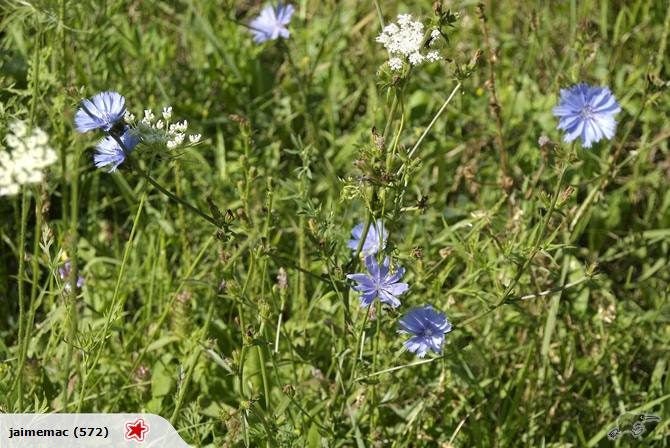
Common chicory, Cichorium intybus, is an erect, somewhat woody, perennial herbaceous plant with bright blue flowers. Various varieties are cultivated for salad leaves, chicons (blanched buds), or for roots (var. sativum), which are baked, ground, and used as a coffee substitute and additive. It is also grown as a forage crop for livestock. It lives as a wild plant on roadsides in its native Europe, and in North America and Australia, where it has become naturalized. "Chicory" is also the common name in the United States for curly endive (Cichorium endivia); these two closely related species are often confused. When flowering, chicory has a tough, grooved, and more or less hairy stem, from 30 to 100 centimetres (10 to 40 in) tall. The leaves are stalked, lanceolate and unlobed. The flower heads are 2 to 4 centimetres (0.79 to 1.6 in) wide, and usually bright blue, rarely white or pink. There are two rows of involucral bracts; the inner are longer and erect, the outer are shorter and spreading. Sugarloaf looks rather like cos lettuce, with tightly packed leaves. Chicory is well known for its toxicity to internal parasites. Studies indicate that ingestion of chicory by farm animals results in reduction of worm burdens, which has prompted its widespread use as a forage supplement. Only a few major companies are active in research, development, and production of chicory varieties and selections, most in New Zealand. Chicory (especially the flower) was used as a treatment in Germany, and is recorded in many books as an ancient German treatment for everyday ailments. It is variously used as a tonic and as a treatment for gallstones, gastro-enteritis, sinus problems and cuts and bruises. (Howard M. 1987). Chicory contains inulin, which may help humans with weight loss, constipation, improving bowel function, and general health. In rats, it may increase calcium absorption and bone mineral density. Chicory has demonstrated antihepatotoxic potential in animal studies.
Details
Shipping & pick-up options
| Destination & description | Price | |
|---|---|---|
| Combine with another item you've paid shipping on | $0.00 | |
| Nationwide 16-17 days, Economy | $7.80 | |
| Nationwide 16-17 days, Economy, Signature | $10.80 | |
| Nationwide 18-21 days, Rural Economy | $13.30 | |
| Nationwide 18-21 days, Rural Economy, Signature | $16.30 | |
| Shipping more than one item | No extra charge | |
| Pick-up available from Huntly, Waikato | Free | |
Estimated delivery times in business days
Payment Options
Pay instantly by card and Ping balance.
Four fortnightly interest-free payments.
Questions & Answers
CHICORY SUGARLOAF - 20 SEEDS
Am I covered by Buyer Protection?
When you make a purchase using any Ping payments like Card or Balance, or Afterpay we are able to protect your trade under our Buyer Protection policy, up to $5,000.
Learn more about Trade Me's Buyer Protection.